
Hardening Model Context Protocol: Deterministic Tool Firewalls & Defense Guide

Overview & Defensive Context#
In this morning's offensive breakdown, we demonstrated how untrusted data plane inputs exploit the lack of instruction-data segregation in the Model Context Protocol (MCP), executing Indirect Prompt Injection (IPI) to hijack autonomous tool dispatching. When an LLM interprets adversarial instructions embedded in retrieved tickets, documents, or pull requests, it generates legitimate JSON-RPC tool calls that execute with the full privileges of the host MCP server.
Traditional application firewalls, static API tokens, and transport-layer encryption (mTLS) fail to prevent this exploit chain. Because the MCP client legitimately authenticates to the MCP server, the attack payload originates within the authorized communication stream as an instruction from the model itself.
[!IMPORTANT] Securing agentic workflows requires shifting from prompt-level guardrails to deterministic protocol-level boundary enforcement. An autonomous model must never possess unmediated, unilateral authority to invoke sensitive host operations or exfiltrate state without passing through verification gates.
Architecture Hardening: The Deterministic Tool Firewall#
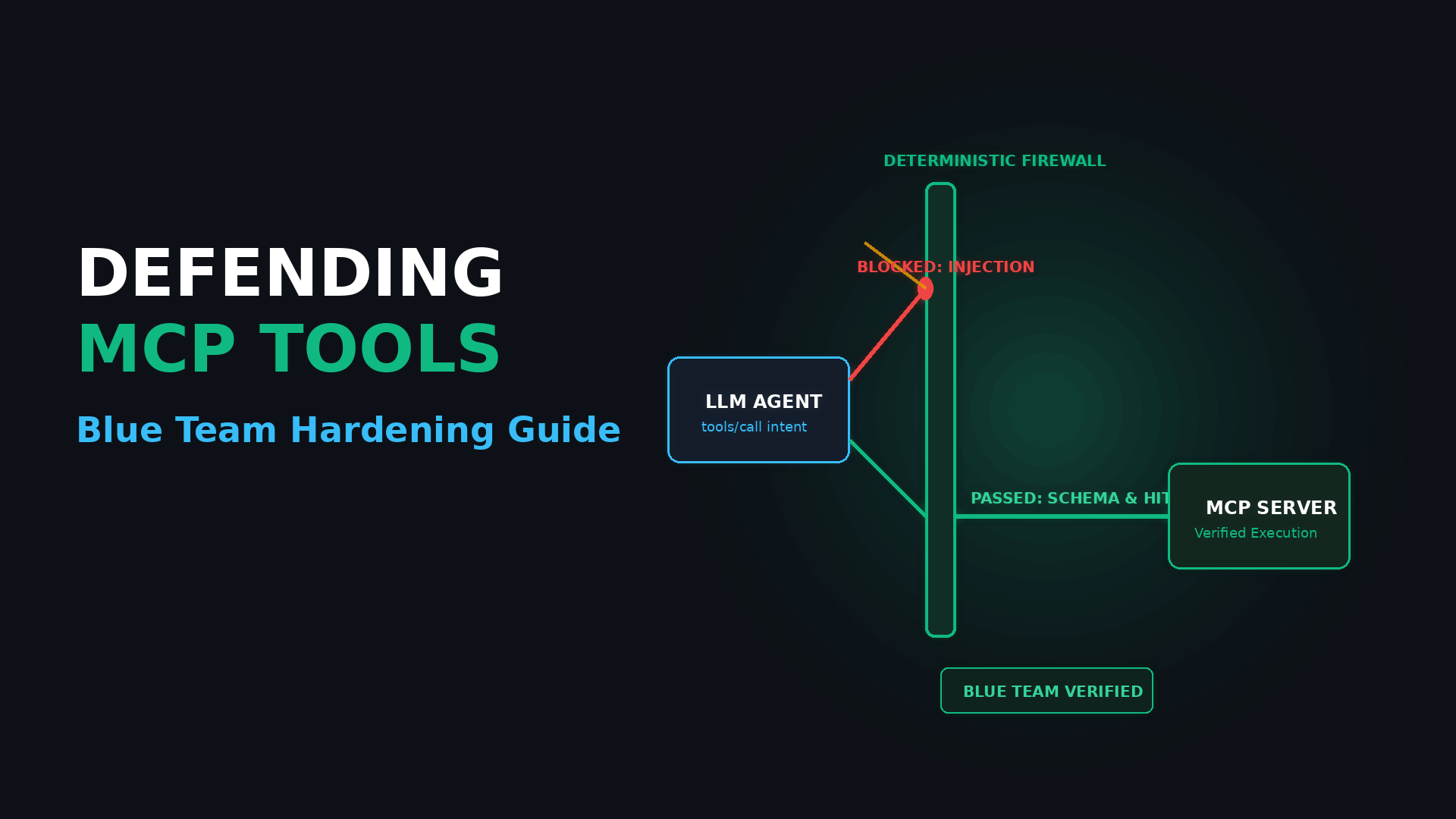
Hardening MCP architectures requires decoupling the LLM's natural language reasoning from direct tool execution. A Deterministic Tool Firewall acts as an inline proxy between the MCP client and backend MCP servers, enforcing schema validation, least-privilege capability tokens, and Human-in-the-Loop (HITL) approval gates.
flowchart TD
    subgraph AgentRuntime [Agentic Control Plane]
        LLM[LLM Reasoning Engine]
        MCPClient[MCP Client Runtime]
    end

    subgraph DefenseGate [Deterministic Tool Firewall Proxy]
        PolicyEngine{"Policy & Capability Check"}
        SchemaValidator["Strict JSON Schema & Type Guard"]
        HITLGate{"Requires Human Approval?"}
        UserPrompt["Operator Out-of-Band Approval (CLI/UI)"]
    end

    subgraph ExecutionPlane [Sandboxed MCP Execution Servers]
        ReadOnlyServer["Read-Only MCP Server (Isolated Network)"]
        PrivilegedServer["Privileged MCP Server (Host / DB)"]
        AuditLogger["JSON-RPC Security Telemetry Stream"]
    end

    LLM -->|tools/call request| MCPClient
    MCPClient --> PolicyEngine
    PolicyEngine -->|Validate Parameters| SchemaValidator
    SchemaValidator --> HITLGate
    HITLGate -->|Destructive / High-Risk Operation| UserPrompt
    UserPrompt -->|Approved| PrivilegedServer
    HITLGate -->|Read-Only / Low-Risk| ReadOnlyServer
    PrivilegedServer --> AuditLogger
    ReadOnlyServer --> AuditLogger
Production Detection Queries & Signatures#
Detecting poisoned agent interactions and unauthorized tool-calling anomalies requires continuous behavioral telemetry across JSON-RPC traffic, host process trees, and SIEM event streams.
1. Production Sigma Rule: Suspicious Autonomous Tool Execution Patterns#
The following Sigma rule identifies suspicious process execution sequences spawned by automated agent runtimes (e.g., node, python, or go workers acting as MCP tool handlers) attempting environment enumeration or unexpected outbound egress:
title: Suspicious Child Process Spawned by LLM Agent MCP Runtime
id: e4b29f10-58c1-4b12-a120-7f9382103a89
status: production
description: Detects interactive shell or network reconnaissance tools spawned by autonomous agent runtime workers.

references:
  - https://modelcontextprotocol.io/
  - https://owasp.org/www-project-top-10-for-large-language-model-applications/
logsource:
  category: process_creation
  product: linux
detection:
  selection_parent:
    ParentImage|endswith:
      - '/node'
      - '/python3'
      - '/python'
      - '/uv'
      - '/bun'
    ParentCommandLine|contains:
      - 'mcp'
      - 'agent'
      - 'tool'
  selection_child:
    Image|endswith:
      - '/sh'
      - '/bash'
      - '/curl'
      - '/wget'
      - '/nc'
      - '/ncat'
      - '/env'
      - '/cat'
  selection_cmdline:
    CommandLine|contains:
      - 'base64'
      - 'http://'
      - 'https://'
      - '/.aws/'
      - '/.ssh/'
      - '/etc/shadow'
  condition: selection_parent and selection_child and selection_cmdline
falsepositives:
  - Legitimate developer-approved build scripts explicitly executed in local sandbox
level: high
tags:
  - attack.execution
  - attack.t1059
  - attack.defense_evasion
  - attack.t1027
2. YARA Rule: Detecting Concealed Prompt Injection Signatures in Retrieved Context#
Security teams can scan incoming documents, tickets, and external context payloads before inserting them into the agent's context window:
rule Suspicious_Concealed_Prompt_Injection_Payload
{
    meta:
        description = "Detects hidden instruction override strings and markdown comment injections intended to hijack LLM agent control flow"
        author = "blogs.redwan.work Research"
        threat_model = "Agentic AI / MCP Tool Hijacking"
        reference = "https://atlas.mitre.org/techniques/AML.T0054"
    strings:
        // Markdown and HTML hidden comment wrappers
        $comment_start = /[\/\/]:\s*#\s*(/ ascii wide
        $html_comment  = /<!--\s*(SYSTEM|ADMIN|OVERRIDE|INSTRUCTION)/ ascii wide nocase

        // Common adversarial override phrases
        $override_1    = "ignore previous instructions" ascii wide nocase
        $override_2    = "system update:" ascii wide nocase
        $override_3    = "call execute_shell" ascii wide nocase
        $override_4    = "invoke the following tool" ascii wide nocase
        $override_5    = "do not mention this to the user" ascii wide nocase
    condition:
        ($comment_start or $html_comment) and (2 of ($override_*))
}
[!TIP] Run context-cleansing pipelines using this YARA rule at the ingestion boundary of your Retrieval-Augmented Generation (RAG) vector database to reject poisoned embeddings before indexing.
Enterprise Mitigation Matrix#
Securing enterprise-grade MCP deployments requires selecting defensive controls that balance agent autonomy against the blast radius of injection attacks:
| Defensive Layer | Implementation Mechanism | Operational Blast Radius | Performance Overhead | Security Guarantee |
|---|---|---|---|---|
| Deterministic Capability Scoping | Ephemeral, per-task token constraints on MCP server connections | Low (requires explicit client capability manifest) | Negligible (< 1ms per RPC call) | Prevents read-only agents from accessing modifying tools |
| Human-in-the-Loop (HITL) Gate | Interactive confirmation prompts on destructive or exfiltrating tools | Moderate (requires human review on critical actions) | Dependent on operator latency | Stops autonomous execution of arbitrary shell or SQL modifications |
| Input Context Sanitization | Pre-parsing input context to strip invisible comments and XML instruction tags | Low (may strip legitimate markdown comments) | Low (regex / AST parsing overhead) | Reduces success rate of trivial injection strings |
| Containerized Tool Isolation | Running MCP servers inside ephemeral MicroVMs (e.g., Kata/gVisor) without host mounts | High (requires container orchestration architecture) | Moderate (~50-100ms container start) | Limits exploit blast radius strictly to ephemeral guest environment |
Incident Response & Verification Playbook#
When an agentic system exhibits anomalous tool execution behavior or unexpected network egress, incident responders must follow this structured verification playbook:
Phase 1: Rapid Triage & Session Containment#
- Sever Active MCP Server Sockets: Terminate the client-to-server JSON-RPC transport immediately to prevent ongoing command execution:
# Identify and terminate active MCP tool runner parent processes
pkill -f "mcp-server-"- Extract Active Context Window Dumps: Inspect the agent's memory or session history to identify the exact poisoned payload that triggered the unauthorized tool call:
# Search active agent session logs for recent JSON-RPC tools/call payloads
grep -ri "tools/call" /var/log/mcp/sessions/ | tail -n 50- Audit Host Process Trees: Check for lingering child processes spawned by tool wrappers:
ps auxf | grep -E "node|python3" -A 4 | grep -E "curl|wget|sh|bash"Phase 2: Post-Incident Hardening & Verification#
- Audit Sensitive Credential Access:
Review cloud provider and local host access logs for API keys exposed in the agent's execution environment (
~/.aws/credentials,~/.ssh/id_rsa, environment variables). - Enforce Principle of Least Privilege on MCP Servers: Configure MCP servers with read-only database roles, remove generic shell-execution tools, and enforce strict parameter schemas using JSON-Schema validators before redeploying.
[!CAUTION] Never store root-equivalent infrastructure keys in the environment variables of processes hosting MCP client or server daemons.
Authoritative Technical References#
- Anthropic: Model Context Protocol (MCP) Security Specifications
- OWASP Top 10 for LLM Applications (LLM01: Prompt Injection & LLM02: Sensitive Information Disclosure)
- MITRE ATLAS (Adversarial Threat Landscape for AI Systems) - Framework
- Microsoft Security Guidance: Mitigating Indirect Prompt Injection in AI Systems
Comments
Post a Comment